
How B2B SaaS companies turn customer testimonials into revenue
Every B2B SaaS buyer asks the same question before signing: “Can you prove this actually works?” Customer testimonials are how you answer that question. But not all testimonials carry the same weight, and the format you choose determines whether your proof opens doors or gets ignored.
What are customer testimonials and why do they matter?
What they all have in common is they let your customers make the argument for you. And in B2B SaaS, where sales cycles are long and buying decisions involve multiple stakeholders, that argument matters more than almost anything else on your website or in your sales deck. 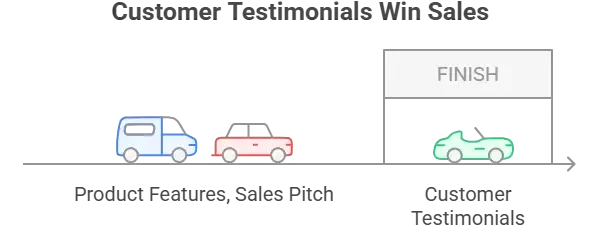
Prospects trust other customers more than they trust your marketing. A bold claim on a homepage is easy to scroll past. The same claim backed by a real company, a real scenario, and real metrics is much harder to dismiss. That’s the difference between social proof that exists and social proof that actually moves opportunities along your pipeline.
But here’s where most B2B companies get stuck. They know customer testimonials matter, and they fully intend to collect and use them, but the effort stalls somewhere between good intention and finished product. The short quotes they gather end up vague and interchangeable. The case studies they plan to write lurk midway down the marketing to-do list and never quite make it to the top. Meanwhile, the sales team keeps asking for more proof, and marketing doesn’t have the bandwidth to deliver it.
The companies that solve this problem share a common trait. Businesses understand that customer testimonials come in several forms, and they choose the right type for the right moment in the buyer’s journey. A star rating builds initial credibility. A short quote reinforces it. But when a prospect is deep in evaluation and needs to justify the purchase to their team, they need something with real weight that is built on quantitative metrics rather than fluff.
That’s where the format of your testimonial starts to matter as much as the testimonial itself.
Already have customer proof you want to put to work? We turn it into a polished case study in 5 days.
Types of customer testimonials
Customer testimonials range from a single sentence on a landing page to a multi-page document that walks a buyer through an entire customer journey. Each type has a role, and understanding where each one works best will help you build a proof library that supports your sales team at every stage of the funnel.
Quote testimonials
These are the short, punchy endorsements you see scattered across most B2B websites. One or two sentences from a named customer, usually paired with their title and company logo. They work well as trust signals on landing pages, in email campaigns, and alongside pricing tables because they’re quick to read and easy to place.
The limitation is depth. A quote like “Great product, really helped our team” checks the social proof box, but it doesn’t answer the questions a serious buyer is asking. There’s no context around the problem that was solved, no indication of how long it took, and no measurable outcome. Quotes build initial credibility. They rarely close deals on their own.
Video testimonials
Video carries a lot of trust because prospects can see and hear a real person vouching for your product. A well-produced customer video can perform extremely well in ads, on YouTube, and on your homepage.
The tradeoff is production effort. You need your customer to agree to be on camera, find time to film, and then edit the footage into something polished. For most B2B SaaS companies, this creates the same bottleneck that slows down every other form of customer proof. The project sounds great in a planning meeting and then sits unfinished for months because scheduling and logistics keep getting in the way.
Social proof and user-generated content
This includes star ratings on G2 or Capterra, customer reviews, social media posts, and any other proof your customers create on their own without you orchestrating it. The big advantage here is authenticity. A prospect who sees dozens of independent reviews on a third-party platform knows those opinions weren’t curated by your marketing team.
The downside is that you have very little control over the message. Reviews tend to be short, unstructured, and focused on whatever the reviewer felt like mentioning that day. Some will highlight exactly the value prop you want to emphasize. Others will talk about your onboarding process or your support team in ways that don’t help a prospect who is evaluating your core product.
Case studies
A case study is the testimonial type that carries the most weight in a B2B sales process. It tells the full story. A real company had a real problem, they chose your product, and here’s what happened afterward, measured in actual numbers.
Where a quote gives you a sentence and a video gives you a feeling, a case study gives a prospect something they can bring to their CFO or their buying committee. It lays out the situation, the reasoning, and the results in a format that mirrors how business decisions actually get made. And because it’s built on quantitative metrics and concrete outcomes, it functions as proof that your product delivers, written in the language that decision-makers already think in.
Case studies also have a practical advantage that gets overlooked. You don’t always need your customer to sit for a formal interview to create one. Companies already have the raw material in most cases. Win notes from sales, KPIs from customer success, a Slack thread about a great result, a social post from the client. That data can be shaped into a compelling, structured story without adding weeks of back-and-forth to your customer’s calendar.
The other testimonial types all have a place in your marketing. But when a prospect is deep in evaluation and looking for proof that your product solves a problem like theirs, a well-built case study is what moves them forward.
What makes a customer testimonial effective?
A case study can sit on your website for years and never influence a single deal. Or it can become the asset your sales team sends more than anything else. The difference comes down to a few principles that separate proof buyers trust from proof they scroll past.
Specificity over vagueness
The fastest way to weaken a case study is to keep it general. Statements like “our client saw great results” or “the platform helped improve efficiency” sound positive but give a prospect nothing to hold onto. There’s no picture forming in their mind. There’s no moment where they think, “That sounds like us.”
Compare that with a study that says the customer was spending 14 hours a week manually reconciling invoices across three systems, and after implementation that dropped to two hours. Now a prospect who wrestles with a similar problem can see themselves in the story. The specificity is what creates that recognition.
Measurable outcomes over adjective-heavy praise
Buyers in B2B SaaS are trained to look for numbers. When a case study leans on words like “transformative” or “game-changing” without attaching them to anything measurable, it reads the same as marketing copy. The customer’s voice disappears and the whole thing starts to feel like it was written by the vendor.
A strong case study quantifies the change. Revenue grew by a specific percentage. Onboarding time dropped from six weeks to nine days. Churn fell by a measurable amount within a defined timeframe. These details do the persuading. The adjectives are just decoration.
A real problem with a clear resolution
The structure of an effective case study follows the way your prospect is already thinking. They have a problem, they’re looking for someone who has solved that same problem before, and they want to see how it played out. If your study opens with a vague description of the customer’s situation and jumps straight to how great your product is, you’ve skipped the part that builds the most trust.
The problem section of a case study deserves real attention. What was going wrong? What had the customer already tried? What was the cost of leaving it unsolved? When a prospect reads a problem description that mirrors their own experience, the rest of the study carries significantly more credibility. They stop reading it as a marketing asset and start reading it as evidence.
The story matters as much as the data
Numbers make a case study credible, but narrative is what makes it readable. A study that lists results without any context around the journey feels like a spec sheet. The best case studies read like a short business story where the data supports the plot rather than replacing it. The customer had a challenge, they made a decision, and here’s what happened. That structure is simple but it’s also the reason case studies outperform other forms of customer proof in the middle and bottom of the sales funnel. Prospects don’t just see results. They see a path that looks like the one they’re considering.
The problem most B2B SaaS companies face with customer testimonials
If you work in B2B SaaS marketing, you already know your company needs case studies. Your sales team has probably asked for them more than once. Your leadership team has probably agreed they’re a priority. And yet, if you’re honest about where things stand, the case studies either don’t exist or there aren’t nearly enough of them.
This isn’t a knowledge gap. Everyone understands the value. It’s an execution gap, and it follows a pattern that shows up across companies of almost every size.
The interview bottleneck
The traditional approach to building a case study starts with scheduling a customer interview. And this is where the timeline starts to unravel. Your customer success team reaches out to a client. The client is busy. They agree in principle but finding 30 minutes takes weeks. Sometimes they stop responding altogether. Sometimes they say yes and cancel twice. Meanwhile, the study sits in draft zero and the marketing team moves on to something more urgent.
The interview model puts your most important sales asset in the hands of someone who has no incentive to prioritize it. Your customer already bought your product. Helping you market it is a favor, and favors are easy to postpone.
Marketing capacity
Even when a customer does agree to participate, someone on your team has to run the interview, pull out the key points, write the narrative, get it reviewed internally, send it back to the customer for approval, and then format and publish it. For a marketing team that’s already managing campaigns, content calendars, product launches, and a dozen other priorities, a single case study can take weeks of elapsed time. Multiply that across the five or ten studies your sales team actually needs and it becomes clear why the project keeps getting pushed.
Case studies feel like hard work because, done the traditional way, they are. They require coordination between multiple teams, cooperation from an external party, and sustained attention from people who are already stretched thin. So they lurk midway down the to-do list and never quite make it to the top.
The fallback
When full case studies stall, teams default to whatever proof they can get quickly. A short quote from a happy customer. Permission to use a logo on the website. A star rating pulled from a review platform. These are better than nothing, and they do contribute to a general sense of credibility, but they don’t give a prospect what they need when they’re deep in evaluation and trying to build an internal business case for your product.
The result is a proof library that’s heavy on one-liners and light on substance. Sales reps end up in late-stage conversations without anything concrete to share, and deals that could have been supported by strong customer evidence have to be won on product demos and pricing alone.
The cost of leaving this unsolved
Every month that passes without a solid set of case studies is a month where your sales team is working harder than they should have to. Prospects who might have converted with the right proof at the right time are falling out of the pipeline or choosing a competitor who gave them more confidence. The irony is that most B2B SaaS companies already have what they need to build these studies. The wins are real. The data exists. The stories are there. What’s missing is a process that doesn’t depend on customer interviews, marketing bandwidth, or months of back-and-forth to get a single study across the finish line.
Sound familiar? Tell us about your customer story and we’ll let you know if you already have enough for a case study.
Why case studies are the highest-converting testimonial type
Every type of customer testimonial contributes something to your credibility. But when you look at where deals actually get won or lost in a B2B SaaS sales cycle, case studies consistently do more of the heavy lifting than any other form of customer proof.
The reason comes down to what a buyer needs at different stages of their decision.
Early in the process, when a prospect is browsing your website or scanning a list of vendors, light social proof works fine. A row of recognizable logos, a few star ratings, a short quote from someone with a relevant title. These signals say “other companies trust us” and that’s enough to keep someone’s attention while they’re still in discovery mode.
But the further a prospect moves through evaluation, the more their questions change. They stop asking “is this company credible?” and start asking “can they solve my specific problem, and what evidence do I have that they’ve done it before?” A quote that says “great product, highly recommend” doesn’t answer that question. A G2 review that mentions good customer support doesn’t answer it either. These are positive signals, but they’re not proof in the way that a buying committee or a CFO would define proof.
A case study answers the questions that matter at this stage because it’s built to mirror the way B2B buying decisions actually work. It starts with a situation the prospect can recognize. It describes a problem with enough specificity that the reader either sees their own challenge reflected back at them or they don’t. It walks through what happened after implementation. And it closes with outcomes that are measured in real numbers.
That structure maps directly onto the three things a prospect is trying to establish before they commit. First, has this company solved a problem like mine? The situation and challenge sections of the study address this. Second, can they prove it worked? The results section, built on quantitative metrics, addresses this. Third, what was it actually like to work with them? The narrative arc of the study addresses this in a way that no other testimonial format can, because there’s room for context, detail, and the kind of specificity that builds genuine confidence.
This is also why case studies tend to have an outsized impact on conversion. Research suggests that case studies can increase conversion rates by up to 70%, and when you think about what they’re actually doing in the sales process, that number makes sense. They give a prospect the ability to build an internal argument for your product using someone else’s real experience. A sales rep can present features and pricing, but a case study lets the prospect’s own peers, people in similar roles at similar companies, make the case instead.
The other formats all have a place in your marketing. Quotes and ratings belong on your homepage and landing pages. Video testimonials work well in campaigns and at the top of the funnel. But when a deal is in motion and your champion inside the prospect’s organization needs something to share with the rest of their team, a well-built case study is the asset that gets forwarded.
How to turn the proof you already have into a case study
Most companies assume that creating a case study begins with a customer interview. That assumption is the single biggest reason case studies don’t get done. The interview creates a dependency on someone outside your organization, and once that dependency exists, your timeline is no longer in your control.
But here’s what tends to get overlooked. Nine times out of ten, you already have enough material to build a strong case study without ever scheduling a call with your customer.
Think about the proof that already exists inside your company. Your customer success team has notes on what changed after implementation. Your sales team remembers the problem the customer was trying to solve when they signed. Product usage data shows adoption patterns. There are KPIs sitting in dashboards that tell the story in numbers. And scattered across Slack, email, and internal docs, there are threads where someone said something like “hey, great news from [client name], here’s what happened.”
Beyond your internal records, customers often leave proof in public without being asked. A LinkedIn post about a win they’re proud of. A review on G2 or Capterra that describes their experience in detail. A quote from a webinar or a conference panel. All of this is usable material.
The shift in thinking is simple. Instead of starting with “let’s schedule a customer interview and build a study from scratch,” start with “what do we already have, and is it enough?”
In most cases, the answer is yes. A short win description from marketing, a recap of the engagement with some supporting data, and a customer quote pulled from a review or a social post will give you the foundation for a complete case study. The challenge, the solution, and the result are all there. What’s needed is someone to shape that raw material into a clear, compelling narrative built around measurable outcomes.
This approach changes the math on case study production entirely. Instead of one study taking two or three months from first outreach to final approval, you can have a finished piece in days. Instead of producing one or two studies per year because the process is so heavy, you can build a library that keeps pace with your sales team’s needs. And instead of relying on your customer to carve out time they don’t have, you’re working with proof that already exists.
It doesn’t mean the customer interview model is always wrong. For some stories, a direct conversation adds depth and detail that nothing else can match. But waiting for that conversation before you start is the reason most companies have a fraction of the case studies they need. The proof is already there. The question is whether you have a process that puts it to work.
Have a customer win you want to turn into a case study? Answer a few short questions and we’ll tell you if you’re ready or what you need to add to get there.
Do it yourself vs. professional case study writing
At this point you might be thinking about writing your next case study yourself. And that’s a perfectly reasonable option, especially if you have someone on your marketing team who enjoys long-form writing, understands your product deeply, and has the time to dedicate to it.
The challenge is that all three of those things need to be true at the same time.
In practice, most marketing teams have people who could write a good case study, but those same people are also running campaigns, managing content calendars, coordinating product launches, and handling a dozen other things that feel more urgent on any given week. Writing a case study requires focused time for research, drafting, internal review, and revisions. It’s the kind of project that gets started with good intentions and then sits in a Google Doc at 40% complete for months because something more pressing always comes up.
There’s also a skill set consideration that doesn’t get talked about enough. Writing a case study well is different from writing a blog post or a landing page. The structure needs to guide a skeptical buyer through a logical progression. The data needs to be presented in a way that feels credible without reading like a spreadsheet. And the narrative needs to stay focused on the customer’s experience rather than drifting into product marketing language. It’s a specific kind of writing, and even strong writers on your team may not have done much of it.
The other route is outsourcing. Large content agencies will produce case studies for you, and the quality can be excellent, but the cost tends to reflect the overhead that comes with a big operation. Turnaround times stretch because you’re one of many clients in a queue. And you’ll often still be responsible for gathering the source material, coordinating with your customer, and managing rounds of review. The bottleneck shrinks, but it doesn’t disappear.
Freelancers and AI tools sit at the other end of the spectrum. The price is lower and the speed can be fast, but the output often reflects the gap in domain knowledge. A freelancer who doesn’t understand B2B SaaS buying cycles will write a study that sounds nice but doesn’t speak the language your prospects think in. An AI-generated draft can give you a starting structure, but without someone who understands what makes a case study actually persuade a buyer, the result tends to land somewhere between generic and unconvincing.
The option we built at Case Study Analytics was designed around the specific problem this page has been describing. You share the proof you already have. We shape it into a structured, data-driven case study that your sales team can put to work immediately. The whole process takes five days, doesn’t require a customer interview, and doesn’t eat your team’s time. If something needs adjusting, revisions are included. Best yet, it’s affordable.
It’s not the right fit for every situation. If you have a strong in-house writer with open capacity and a customer who’s eager to participate in a full interview, you may get a great result doing it yourself. But if the reality is that your studies keep getting delayed, your proof library is thinner than it should be, and your sales team needs something they can send to prospects this month, removing the bottleneck entirely is worth considering.
Frequently asked questions about customer testimonials
What is the difference between a testimonial and a case study?
A testimonial is any form of customer proof, from a one-line quote to a detailed written story. A case study is a specific type of testimonial that goes deeper. It follows a structure, typically covering the customer’s challenge, the solution, and the measurable results. Think of testimonials as the broad category and case studies as the version that carries the most weight in a B2B sales process because they give prospects the context and data they need to make a confident buying decision.
How do I ask a customer for a testimonial?
The traditional approach is to email your customer and ask if they’d be willing to participate in a case study interview. This works sometimes, but as most B2B marketing teams know, it often leads to weeks of follow-up and rescheduling. A simpler starting point is to look at what your customer has already said publicly. Check G2 reviews, LinkedIn posts, quotes from webinars, or comments they’ve made in email threads. You may already have a usable testimonial without needing to ask for anything new. If you want to turn that into a full case study, you can build from the proof you’ve already gathered internally rather than depending on your customer’s calendar.
How long should a B2B case study be?
Most effective B2B case studies fall between 800 and 1,200 words. That’s long enough to cover the challenge, solution, and results with genuine specificity, but short enough that a busy decision-maker will actually read the whole thing. Going much shorter tends to sacrifice the detail that makes a study credible. Going much longer risks losing the reader before they reach the results.
Do I need my customer’s permission for a case study?
If you’re naming the customer, yes. You should always get approval before publishing a case study that identifies a specific company or individual. However, there are a few things worth knowing. If your case study is built from information that’s already public, like a review your customer posted on G2 or a result they shared on LinkedIn, you’re working with material they’ve already put into the world. You still want to let them know, but the conversation tends to be much easier when you’re not asking them to create something new. Some companies also publish anonymized case studies that describe the customer by industry and company size without using their name, which can be a good option when a client is supportive but their legal team is cautious about formal endorsements.
How many case studies does a B2B company need?
There’s no single number that works for everyone, but a useful rule of thumb is to have at least one case study for each major buyer persona or industry vertical you sell into. A prospect in financial services wants to see that you’ve succeeded with a company like theirs, and a study about a healthcare customer, no matter how strong, won’t fully scratch that itch. If your sales team is regularly getting into late-stage conversations without relevant proof to share, that’s a clear sign you need more. Most growing B2B SaaS companies find that somewhere between five and ten well-targeted case studies gives them meaningful coverage across their key segments.
Can I create a case study without interviewing my customer?
Yes. This is one of the most common misconceptions about case study production. While a customer interview can add richness to a story, it’s not a requirement for creating a strong, credible study. Companies typically have more usable material than they realize. Internal recaps of a project, KPIs and usage data, notes from the sales or customer success team, and public statements the customer has already made all provide a solid foundation. The key is having someone who knows how to pull those pieces together into a structured narrative built around measurable outcomes.