

If you work in B2B marketing, you’ve probably been in this meeting. Someone on the sales team mentions a great customer win. The VP of Marketing says “we should turn that into a case study.” Everyone agrees. It goes on a list. And then… nothing happens.
You’re not alone if that sounds familiar. According to the Content Marketing Institute’s 2025 survey, 75% of B2B marketers say they actively use case studies as a content format. Sopro found that 69% of marketers consider case studies the single most effective content type they have. And when you look at the buyer side, it makes sense. Brixon Group’s 2025 research found that 73% of B2B decision-makers say case studies significantly influence their purchasing process.
Everyone agrees they’re important. Almost nobody has enough of them.
That same Brixon Group research showed only 34% of companies use case studies effectively. Think about what that gap looks like in practice. A SaaS company closes 40 deals in a year, and maybe two of those become published case studies. A services firm lands a transformational project for a well-known client and the closest thing to a case study is a paragraph buried on their “About” page.

The reason this matters goes beyond having a gap on your website. Forrester’s 2025 data shows that 67% of B2B purchasing decisions happen before a buyer ever talks to your sales team. Those buyers are doing their homework right now, reading your competitors’ customer stories, comparing proof points, and building shortlists. If your best wins are sitting in a CRM note or a Slack thread instead of on your website, you’re invisible during the part of the buying process that matters most.
And that’s the kind of cost that never shows up in a report because nobody tracks the deal they lost to a competitor who simply had better proof available.
Why case studies keep stalling out
When you look at how most B2B companies try to produce case studies, the same three problems show up over and over again. And they usually have nothing to do with writing ability or marketing talent. They’re process problems.
The customer says yes, then disappears
This is the big one. Most case study workflows start with reaching out to a customer and asking them to participate in an interview. It sounds simple enough, but anyone who has tried it knows what usually happens. The customer agrees in principle. Then scheduling takes three weeks. Then their legal team wants to review the concept before anyone talks. Then a quarter ends and they get busy. Then the marketing person who initiated the project moves on to something more urgent. Three months later the “case study” is still a half-finished draft sitting in a Google Doc that nobody has opened since October.
The Simons Group, a B2B content agency, points out that even customers who had outstanding results will sometimes insist on full anonymity, which sends the team back to square one debating whether an anonymized study is even worth publishing. Some companies fall back on what amounts to triage. They grab a quick quote, get permission to use the customer’s logo, and call it a day. That’s better than nothing, but it’s a long way from a real case study that can move a prospect through a buying decision.
The “perfect story” problem
The second trap is waiting for the perfect case study before publishing anything. Marketing teams tend to hold out for the dream scenario. A recognizable brand name, a dramatic before-and-after, a 300% ROI, and a customer who is happy to go on camera and sing your praises. That story might come along once a year if you’re lucky.
Meanwhile, the team closed 30 other deals where real customers got real results. Maybe the numbers weren’t jaw-dropping. Maybe the company wasn’t a household name. But those stories would still resonate with a prospect at a similar company facing a similar problem, which is actually how case studies work best. Research from Edelman in 2025 found that 72% of B2B decision-makers connect more strongly with case studies that focus on a relatable customer perspective than ones that lead with impressive brand names or massive numbers. The prospect reading your case study isn’t asking “did they work with Google?” They’re asking “have they solved a problem like mine?”
Every month spent waiting for the perfect story is a month where your website has nothing to show buyers who are actively researching solutions. And those buyers aren’t waiting around. Forrester estimates that 67% of them will have made up their minds before they ever reach out to your sales team.
There’s no repeatable process
The third problem is the most common and probably the least discussed. Most B2B companies don’t have a case study production process. They have a case study intention. Someone volunteers to write one up when things slow down. Things never slow down.
Content Marketing Institute has consistently reported that B2B marketers struggle to connect content efforts to the buyer’s journey, and case studies are one of the formats that suffer most from this. It’s not that teams don’t care. It’s that case studies require coordination across marketing, sales, customer success, and sometimes legal. They take real time and real effort. And when 54% of B2B marketers say they’re already struggling with limited resources, according to CMI’s data, the case study project becomes the thing that gets pushed to next quarter. Then the quarter after that.
Compare that to blog posts, which 92% of B2B marketers produce regularly. Blog posts are easier to ship. One person can write one in a day. Case studies feel heavier by comparison, so they keep sliding down the priority list. The result is that most B2B companies have dozens of blog posts and maybe a handful of case studies, which is the exact opposite of what their buyers are looking for when making a purchasing decision.
What the best B2B case studies actually get right
So if most companies are stuck in the cycle of good intentions and stalled projects, what separates the ones that actually build a working library of case studies? It comes down to three things, and none of them require a bigger budget or a bigger team.
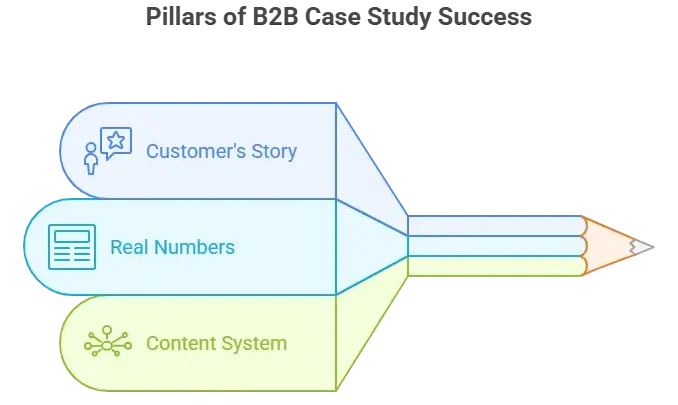
They tell the customer’s story, not their own
This sounds obvious, but read through most B2B case studies on the web and you’ll notice a pattern. The company spends two paragraphs talking about the customer’s challenge and then five paragraphs talking about their own product features. The case study ends up reading like a product page wearing a costume.
The best B2B case studies flip that ratio. They spend most of their time inside the customer’s world. What was going on in their business? What pressure were they under? What had they already tried that didn’t work? The solution shows up naturally as part of that story, but the customer stays at the center of it.
There’s data to back this up. Edelman’s 2025 study found that 72% of B2B decision-makers identify more strongly with success stories that focus on the customer’s perspective. And it makes sense if you think about how a prospect actually reads a case study. They’re not there to admire your product. They’re scanning for a situation that looks like theirs. If they find it, they keep reading. If the first thing they see is a feature list, they bounce.
HubSpot is one of the better examples of this in practice. Content Matterz highlighted a HubSpot case study about the British Red Cross Training program, where the story focused on how the team grew its mission through better marketing and landed on specific outcomes like 66% revenue growth and 69% ROI in the first year. A reader walks away remembering the organization’s growth journey, not a list of CRM capabilities. That’s the difference between a B2B case study that influences a purchase decision and one that just takes up space on your website.
They show real numbers
A case study without measurable results is really just a testimonial. And testimonials are fine, but they don’t carry the same weight when a buyer is trying to justify a purchase to their CFO or a committee of stakeholders.
The average B2B buying process now involves around 10 stakeholders, according to Thunderbit’s 2026 benchmarks report. That means your case study isn’t just being read by the person who found your website. It’s being forwarded to finance people, operations leads, and executives who want to see evidence before they agree to take a call. Vague language like “improved efficiency” or “streamlined their workflow” doesn’t give those stakeholders anything to work with.
The strongest B2B case studies include specific metrics. Revenue growth in percentages. Time saved in hours per week. Cost reduction in real dollar amounts. Customer retention improvements. Whatever the measurable outcome was, put it in the study. If you can’t share exact figures because of confidentiality, Brixon Group’s 2025 research suggests using percentage changes or index-based comparisons. Something like “reduced onboarding time by 40%” communicates real impact without exposing sensitive data.
This is also where a lot of companies get stuck thinking they need a massive, dramatic number to make a case study worth publishing. They don’t. A prospect at a mid-size logistics company isn’t necessarily impressed by a case study about an enterprise saving $10 million. They want to see a company their size solving a problem they recognize. A B2B case study showing a 25% reduction in processing time at a 200-person company might be far more persuasive to that prospect than a Fortune 500 success story they can’t relate to.
They treat one story as a whole content system
One of the most underappreciated things about a well-built B2B case study is how many other pieces of content it can become. Most companies think of a case study as a single asset. You write it, you put it on the website, you’re done. The companies that get the most value out of their case studies treat each one as raw material for an entire content ecosystem.
A single customer story can become a full-length case study on your website, a one-page sales leave-behind, a short LinkedIn post highlighting a key result, a quote graphic for social media, a slide in your sales deck, and a reference point in a blog post about the problem your customer faced. That’s six or seven assets from one story, and none of them require starting from scratch.
This matters because B2B buyers engage across multiple channels during their research. Thunderbit’s data shows the average buyer journey now involves 88 touchpoints across four different channels. Your case study content needs to show up in more than one place to have a real chance of reaching buyers during that process. When a prospect sees a compelling stat from your customer story in their LinkedIn feed, then later finds the full case study on your website, then sees a related slide in your sales presentation, that repetition builds familiarity and trust in a way that a single webpage never could.
A simple exercise you can do this week
If you’ve recognized your own team in any of what I’ve described above, here’s something practical you can do right now. It takes about 30 minutes, and it will probably change the way you think about your B2B case study backlog.
Pick your last 10 closed deals. For each one, ask three questions.
First, do you have a measurable outcome? This doesn’t have to be something the customer handed you in a formal review. Look at what you already know internally. Maybe your customer success team tracked an onboarding metric. Maybe the account manager mentioned a result on a call that got noted in the CRM. Maybe the customer posted something on LinkedIn about the impact your product had on their quarter. You likely have more data than you think. It’s just scattered across tools and conversations instead of collected in one place.
Second, could this story work without a formal customer interview? This is the question most marketing teams never think to ask, and it’s the one that changes everything. There’s a widespread assumption in B2B marketing that a case study has to start with a scheduled interview, a recorded conversation, a transcript, and a polished set of approved quotes. That process works when it works, but as we covered earlier, it’s also the single biggest reason case studies stall out for months or never get finished at all.
Look at what you already have for each deal. A short write-up from your sales team about why the customer chose you. A Slack message from the account manager sharing a great result. A social post from the customer. An internal project recap with KPIs attached. A testimonial the customer already gave you for a review site like G2 or Capterra. Nine times out of ten, there is enough existing material to build a solid, data-driven B2B case study without ever needing to schedule an interview that takes weeks to land and months to approve.
That doesn’t mean customer interviews aren’t valuable. They are. But treating the interview as a prerequisite rather than an enhancement is what keeps most companies stuck at two or three published case studies when they should have twenty.
Third, does this story map to an objection your sales team hears regularly? Talk to your reps and ask them what pushback comes up most often in deals. Maybe prospects worry about implementation timelines. Maybe they question whether your solution works for companies their size. Maybe they’re nervous about switching from an incumbent vendor. If one of your closed deals directly addresses that concern with a real outcome, that’s not just a case study candidate. That’s a sales tool your team will actually use.
Score each of your 10 deals against those three questions. Anything that hits two out of three is ready to become a published B2B case study. Most teams who go through this exercise are surprised to find they have five or six viable stories that nobody ever thought to write up, simply because the material was already sitting in their existing systems and nobody recognized it as case study material.
The real shift here is understanding that a case study doesn’t have to be a big production. It needs a real customer problem, a clear solution, and a measurable result. If you have those three elements in any form, whether that’s in an email, a project recap, or a quarterly review deck, you have what you need to get a B2B case study published and working for your pipeline.
The proof gap is costing you deals you’ll never hear about
Here’s the thing about not having enough B2B case studies on your site. You’ll rarely get direct feedback about it. A prospect isn’t going to email you and say “I was interested in your product but I couldn’t find enough customer evidence, so I went with your competitor.” They just leave. They move on to the next vendor on their shortlist who had three or four published case studies that made the decision feel safer.
And safety is really what this comes down to. B2B purchases involve real risk. Budgets are tight. Buying committees are getting larger. Thunderbit’s 2026 data shows the average B2B deal now involves around 10 stakeholders and 88 touchpoints across the entire buyer journey. Every one of those stakeholders is looking for reasons to say yes and reasons to say no. A strong B2B case study that mirrors their situation and shows a measurable outcome gives them a reason to say yes. An empty case study page, or one with a single outdated story from 2021, gives them a reason to keep looking.
The companies that figure this out tend to share a common trait. They stop treating case studies as a special occasion and start treating them as a regular output. Not every story needs to be a showpiece. Not every customer needs to go on record by name. Not every result needs to be a 10x improvement. What matters is having a consistent, growing collection of real proof that shows a range of industries, company sizes, and problems solved. That library becomes one of the most valuable sales assets the company owns, and it compounds over time. The twentieth B2B case study makes the first nineteen more credible, because volume itself communicates something. It says this company has done this many times, for this many different types of customers, and it keeps working.
Most B2B companies already have the raw material to build that library. The wins have already happened. The results already exist. The customer stories are sitting in CRMs, project recaps, Slack channels, and quarterly reviews. The gap between where most companies are and where they want to be is smaller than they think. It’s usually a process problem, not a content problem.
If you’ve made it this far, I’m curious. What’s the biggest thing that has kept your team from publishing more case studies? Is it the customer approval process? Limited bandwidth on the marketing team? Uncertainty about which stories are worth telling? I’d genuinely like to hear what the bottleneck looks like at your company, because I think this is a conversation more B2B teams need to be having openly.